Wednesday, May 29, 2013

Janet's Brown: A Classic Recipe

Mike "Tasty" McDole
There are some classic homebrew recipes out there that have carved a name for themselves in the community over time.  Their prowess is passed on by word-of-mouth (or click-of-mouse) and they represent both a legacy of innovation and a snapshot of past moments in homebrewing's evolution.  Two examples that come to mind are Dave Brockington's Sister Star of the Sun IPA and Charlie Papazian's Goat Scrotum Porter.  Many people have brewed them and they have gained notoriety and/or cache in the process.  They have staying power because they are groundbreaking.  Both recipes above have been around for decades.  While I haven't brewed Goat Scrotum Porter, I made my own version of Sister Star of the Sun, and it's not hard to see why homebrewers consider it special.  How many times has this beer been brewed? Thousands upon thousands of times, I would imagine.

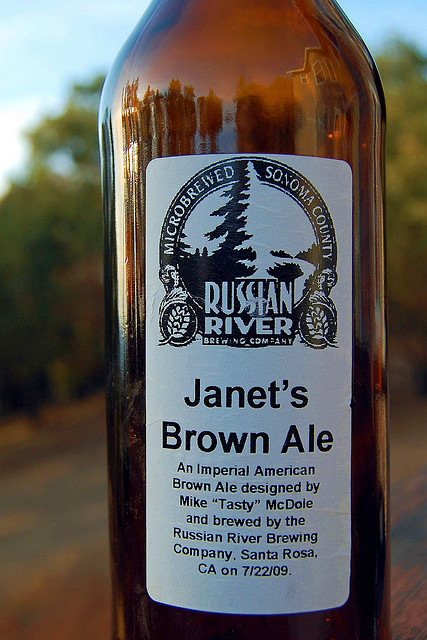
I'd like to add Mike "Tasty" McDole's Janet's Brown Ale to the list of classic recipes.  It's a hoppy version of an American Brown Ale, and it features some classic American hops in Northern Brewer, Centennial and Cascade.  With an ABV above 7%, it falls into the fictional style category: Imperial Brown Ale.  I first tried this beer in homebrew form as made by Lewy in 2011.  It's smooth and nutty, with a slight creaminess to it that belies its ABV.  The color is a complex 28 - 30 SRM and the hops make themselves known in both the aroma and taste.  At NHC 2011 in San Diego I had a chance to talk with Tasty and he explained some of his thoughts about the recipe, most notably his attempt to keep the different flavors in balance.  I think he did an excellent job formulating his hop additions, and that it's the way that the hops combine that sets Janet's apart from imitators.  In 2012 I had a chance to try Janet's on tap as interpreted by Vinnie Cilurzo.  On a trip to the Bay Area, I stopped by Russian River and had a glass of Janet's that was one of the better beers I've tasted in a long while.

I brewed Lewy's version (#5) of Janet's Brown Ale earlier this month and have since started to condition it.  All signs point to it being a great (maybe even classic) beer.

Saturday, May 4, 2013

NHC 2013 First Round Results

The more that I brew, the more specific feedback I need to get better.  A decade ago, when I made my first few beers, I just wanted to make something palatable.  If it tasted good enough and the ABV was at a healthy level, I was pretty happy.  In the course of brewing the past 600+ gallons, my idea of a good beer has changed significantly.  After reading The Mad Fermentationist's recent post about The Four Stages of Homebrewing, I'd like to think I'm somewhere between Advanced and Expert (and probably more the former than the latter).  In addition to those close to me developing the experience, familiarity with terminology and palate sensitivity to provide higher quality notes and constructive criticisms, my recipe refinement has started to rely on the palates of others beyond myself and my circle of friends.  Most of the beers I make are good, but not all of them are great.  When I make changes to a recipe or process, it's generally a small tweak or a minor ingredient adjustment.  That's one reason why entering beers into competitions has been enlightening.  The feedback that I get is more technical and accurate and the bias (my own or that of friends) is removed, making for an honest assessment of the beer.

NHC 2013 First Round Scoresheets
I entered my third competition last month, submitting two beers to the First Round of the National Homebrew Competition.  NHC requires 5 bottles, and I usually keg, so I entered beers that I thought were good and that I had enough of.  I entered KTG into Category 13F - Imperial Stout and III into Category 17B - Flanders Red Ale.  I love both beers, and I got some great feedback from judges and a result I was happy with: KTG advanced to the Second Round of the Competition with a 3rd place score of 40.5 in the Stout Category.  Here's a sampling of the judge's perceptions in their own words:

BEER: KTG - Imperial Stout (13F)

AROMA: medium-low malt aromas; dark chocolate and coffee; fig, plum, dark cherry; some sherry

APPEARANCE: pitch black with black highlights; opaque in clarity; head has a creamy tan silk texture

FLAVOR: dark chocolate and roasted coffee; complex ester profile; no detectable hops; alcohol detectable; sherry-like quality, possibly age

MOUTHFEEL: medium-full bodied with moderate carbonation; no astringency

OVERALL IMPRESSION: complex and delicious; additional hops for more complexity

SCORE: 40.5/50                    PLACE: 3rd out of 45 entries
------------------------------------------------------------------------------------------
BEER: III - Flanders Red Ale (17B)

AROMA: moderately fruity; tart cherries, rd plums, cassis; woody, piney, no hops; funky aroma evident but not overwhelming

APPEARANCE: slight haze; medium tawny, no head

FLAVOR: good restrained level of tartness; dark fruit; could use more residual malt character

MOUTHFEEL: fuller body with low to no carbonation; somewhat syrupy

OVERALL IMPRESSION: good example; each taste reveals new levels; could use a more complex malt bill

SCORE: 33.5/50                    PLACE: none

3rd place finish
Unsurprisingly, my own biased opinion assigns a higher score to III, but I think most of the things that the judges shared were accurate.  When both judge sheets mentioned  greater malt complexity, I realized that I had been tasting its absence without really identifying it.  I have high hopes for KTG in the Second Round: new judges and fresh perceptions, but stiffer competition to be certain.  If it doesn't go any farther, I'd still be happy.  I want to rebrew both beers and make those small changes that turn a good beer into a great one.          

Wednesday, April 24, 2013

Ringing the Final Bell

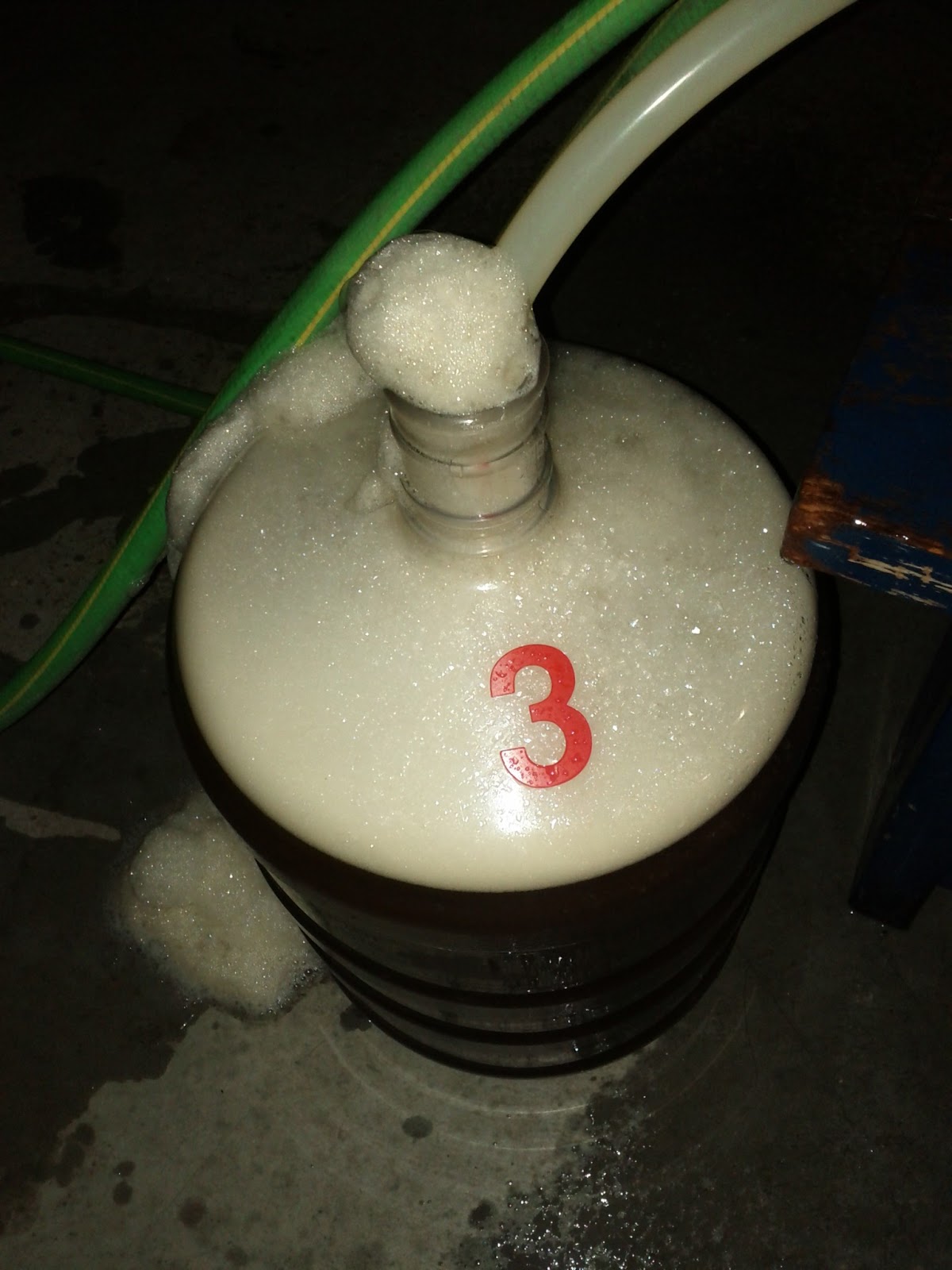
Foaming out of the chiller.
My Dad retired about a month ago.  He and I have been working together for a decade, and seeing his face and connecting with him on a daily basis has been a blessing that few children are able to share with their parents.  My Dad's a pretty amazing guy, too.  He has a huge heart.  He's tireless and passionate about his work, almost to a fault.  I'm happy to say that I'm a little bit like him.  Working with him changed the dynamic of our relationship and made us closer, and his absence is something that I feel acutely.  If I really think about it, I realize that we became adult friends at work.  When you're trying to raise your kids you can't be their friend.  You can be friendly, but that authoritative distance has to be maintained if you really want the best for them.  My Dad was never overbearing or domineering, but as I grew up and we worked together, I had the chance to see him in a different light.  We became friends, and his absence makes me realize how special that relationship is.

He asked me to brew a beer for his retirement party this summer.  His request? Amber Ale.  He's a fan of Sierra Nevada, so I decided to make adjustments to a tried and true Pale Ale recipe, adding additional color and hop presence.  The result is Final Bell Amber Ale:


Malts and Grains
11.50 pounds 89.5% of grist
1.25 pounds 9.7% of grist
0.10 pounds 0.8% of grist
12.85 pounds
Total Grain Weight (Water Amounts)
100% of grist
Reference
Hops
0.33 ounces 13% Pellets @ 60 minutes 
Type: Bittering
Use: Boil
4.3 AAUs
0.50 ounces 8.9% Pellets @ 30 minutes 
Type: Flavor
Use: Boil
4.5 AAUs
1.00 ounces 5.5% Pellets @ 10 minutes 
Type: Aroma
Use: Aroma
5.5 AAUs
1.00 ounces 5.5% Pellets @ 0 minutes 
Type: Aroma
Use: Dry Hop
5.5 AAUs
2.83 ouncesTotal Hop Weight19.7 AAUs
Boil
Total Boil Time:60 minutes
Reference
Yeast
Name:California Ale
Manufacturer:White Labs
Product ID:WLP001
Type:Ale
Flocculation:High
Attenuation:76%
Temperature Range:68–73°F
Amount:35 ml


I brewed this beer over the course of an afternoon and it went exactly as planned.  I mashed at 153 degrees F for an hour and gathered 5.5 gallons of wort.  I'm hoping the addition of Amarillo hops will give this beer additional complexity.  I may dry hop it if it seems appropriate after primary fermentation.  Next up?  Cascadian Dark Ale and a rebrew of KTG.

Sunday, April 21, 2013

BJCP: "It's Tough But Fair"


I passed the BJCP Tasting Exam last August and have been slowly immersing myself in the process of evaluating beer objectively.  When people unfamiliar with craft beer talk to you about being a beer judge, the reactions are pretty typical of what you might expect.  People think you get paid to drink beer or that judging is an excuse to over indulge.  The truth is that being a beer judge is actually pretty challenging.  For the uninitiated, I thought I'd share some information about the BJCP, and maybe provide some insight for those of you thinking about judging beers, too.

The Process

The BJCP has gone through some changes recently and the process of becoming a part of the BJCP has been steamlined significantly.  Becoming a judge is a three part process, but continuing education and experience is an essential component.

Entrance Exam

This online assessment consists of 200 questions that have to be answered in one hour (over 3 questions/minute!) and covers the BJCP Style Guidelines and other beer and brewing topics that are essential knowledge for a judge.  I studied for the test for a solid week, spending time each night after work reading through the style guidelines and thinking about/tasting beers in different styles.  I was able to pass the first time, but it was a lot of questions in a short period of time.  Having the style guidelines around as a reference was helpful, but going into the test without any preparation would have been disastrous.

Tasting Exam

After passing the Entrance Exam you're eligible to sit for the Tasting Exam.  The exam involves tasting 6 different beers and evaluating them as you would in a beer competition.  You have 15 minutes to judge each beer, a process that involves the application of sensory skills to the beer and ends with those interpretations being communicated on the judging sheet.  You're told the beer style, just as you would be in a real competition, but everything else is on your own.  Beers can be doctored to make them taste different or can be miscategorized.  You're not allowed any notes or aids during tasting.  Passing scores on the Tasting Exam play a part (along with Experience Points) in determining your BJCP rank.

Experience Points

When you participate in a beer competition as a judge, proctor or organizer you earn experience points which help you advance through the ranks of the BJCP.  This makes sense, as the most capable judges are the most seasoned and practiced.  Here's how the rankings shake out:

Rank
Tasting Exam Score
Experience Points
Apprentice
Less than 60%
N/A
Recognized
60-69%
N/A
Certified
70-79%
5
National
80-89%
20
Master
90% or above
40


There are additional rankings associated with Grand Master and the levels of Grand Master that one obtains with additional experience and service to the BJCP.

Judging table at AFC
So what's it like to judge beer in a competition?  I judged the first round of the San Diego section of the NHC last week.  I also judged the America's Finest City Homebrew Competition earlier in the year.  A month before you get an email from competition organizers asking you to participate and inquiring about your style preferences.  Before the competition date you are told what style you'll be judging.  Everyone meets at a certain place (in this case an Episcopal Church) at a certain time.  There's a bunch of socializing, talking and some homebrew sharing.  Then they serve a meal and go through the procedures related to judging appropriately.  You spend the next hour(s) drinking beer with a partner, writing down individual thoughts and impressions and then discussing your results with that person.  It's a pretty enlightening experience, as you basically bounce your thoughts and opinions off of another person/palate.  Beers that score well are set aside for a mini Best Of Show (BOS).  The most experienced judges in a style category drink and compare all of the selected beers, making a final decision about which is best.  And that's it.  You're hand is cramped from writing.  Your mouth is dry from eating saltines to cleanse your palate between beers, and your knowledge base has been expanded.

One of the best things about beer judging is the chance to meet people who have a similar passion for beer and brewing.  I learned a lot from the judges that I worked with both times and I look forward to judging more.  It's interesting to think about the role of labels and categorization in something like beer that has so many variations and is so dependent on individual taste.  On the one hand, it's impossible to compare beers and learn more about them without guidelines to follow.  On the other hand, many of the most interesting and exciting beers are those that ignore (or explode) the superficial parameters we use to categorize them.  Philosophical concerns aside, it's all part of the process of enhancing one's knowledge and finding new ways to enjoy something that has innumerable variations.  Judging beer properly is challenging.  I suppose that's why the BJCP website features the slogan: "It's Tough But Fair."

There's a wealth of additional information to be found on the BJCP's website.  It's valuable for those interested in being part of the BJCP or for those just interested in learning how to evaluate beer:

http://www.bjcp.org/index.php

Saturday, April 13, 2013

The Lurker Chocolate Peanut Butter Coffee Porter

With coffee as the required ingredient for the next homebrew competition, I started doing some research and thinking about the type of beer I wanted to make and how to add the coffee.  I like the taste of coffee when it's not overly bitter, but I rarely drink it because I don't like caffeine.  In the spirit of the competition, I first thought I wanted to brew something without dark malts and really showcase the coffee without the intrusion  of roasted malt flavor.  After trying some different commercial examples (Mikkeller Spontankoppi, Ballast Point Victory At Sea, Kona Pipeline Porter, Haandbryggeriet Coffee Porter among others) I pretty much embraced something that was already intuitively known: darker beers lend themselves better to coffee additions.  In the end, I chose to brew something that incorporated other ingredients I've been wanting to use for a while, in addition to the coffee.

During San Diego Beer Week last November, I had a chance to try Karl Strauss' Peanut Butter Cup Porter and was amazed at how much peanut butter flavor came through in the final product.  They used powdered peanut butter when making it, which keeps undesirable oil out of the beer without compromising the peanut butter flavor.  They also incorporated cocoa nibs into the brew, the rawest and strongest form of chocolate flavoring.  I decided to try the same thing on a homebrew scale, using PB2 and also including cocoa nibs.  The addition of coffee would add another (hopefully desirable) element to an already complexly flavored beer.  All three flavors should make for something pretty ridiculously decadent-more calories than any reasonable person needs to consume at any one time-so I named it The Lurker because it should stay with you for a while, no matter how much Insanity you do.

Karl Strauss' version was a Brown Porter.  I decided to brew a Robust Porter and came up with the following recipe:


Malts and Grains
9.00 pounds 60.4% of grist
1.80 pounds 12.1% of grist
1.20 pounds 8.1% of grist
0.60 pounds 4% of grist
1.20 pounds 8.1% of grist
0.60 pounds 4% of grist
0.10 pounds 0.7% of grist
0.40 pounds 2.7% of grist
14.90 pounds
Total Grain Weight (Water Amounts)
100% of grist
Adjuncts
1.00 poundsLactose (Milk Sugar)
1.00 poundsPB2
1.00 poundsPB2 - Chocolate
Non-Fermentables
4 ozCacao Nibs
16 ozCold Pressed Coffee
Reference
Hops
1.00 ounces 14.2% Pellets 
Type: Bittering and Aroma
Use: First Wort
14.2 AAUs
0.75 ounces 5.6% Pellets @ 20 minutes 
Type: Flavor
Use: Boil
4.2 AAUs
1.75 ouncesTotal Hop Weight18.4 AAUs
Boil
Total Boil Time:60 minutes
Reference
Yeast
Name:Dry English Ale
Manufacturer:White Labs
Product ID:WLP007
Type:Ale
Flocculation:High
Attenuation:75%
Temperature Range:65–70°F
Amount:500 ml


I brewed 7.5 gallons last Wednesday.  I mashed at 152 degrees F for an hour and had a rolling 60 minute boil.  The lactose was added with about 20 minutes left in the boil and should contribute some sweetness and body.  Two gallons were used to make Dregs beers (DREGS #9 and DREGS #10), and the other 5.5 gallons was innoculated with 500 ml of WLP007 Dry English Ale Yeast and placed lovingly in the fermentation chamber.  I'll be adding the cocoa nibs and PB2/PB2-Chocolate in secondary in two separate additions, allowing at least a week (maybe more) of contact time for both.  I anticipate a restarting of fermentation with the addition of the PB2.  I'm not sure how many gravity points two pounds of PB2 will contribute, but the final beer should be pretty big.  The original gravity after chilling was 1.058.

As for the coffee, I want it to take a prominent role in the flavor, but not be overly bitter.  I'm going to cold press decaffeinated French Roast coffee (not sure what brand yet) and add sixteen ounces to the bucket at bottling.  I'm hoping that the coffee flavor will shine in the final beer.

Sunday, April 7, 2013

Recipe Refinement | Special Competition Ingredient

3 Fountains IPA/Grassmarket IPA Split Batch

10 gallon IPA split batch coming out of the chiller
Recipe refinement is a glaring weakness of mine.  I rarely repeat brew a beer and I'm not exactly sure why.  Maybe it's because I always have an idea for something different and my brewing schedule can't keep up (it's getting harder and harder to find time to brew these days).  Or maybe it's because I usually want to drink something that I can't find anywhere else and the perfect pale ale, porter, IPA stout etc. has already been done beautifully by so many others.  In any case, I admit I don't have a whole lot of reference when it comes to the influence of individual ingredients.  Sure, I've played with hops and different yeasts and grains as well as some unorthodox ingredients, but comparative knowledge eludes me somewhat.  I have the capability of making 10 gallon batches, but it's only happened a few times.  So a few weeks ago I set out to brew an IPA with the influence of yeast in mind.  I had a lot of success making Chad Y's 100% Brett B Baltic Porter and I wanted another clean-fermented Brett beer to drink.  I've also been keeping up with Modern Times progress toward opening locally and have been following the Mad Fermentationist's brewing experiments as a Modern Times consultant.  So, I copied the malt bill for the Modern Times Super 100% Brett IPA test batch and adjusted the hops to my preferences.  I brewed 10 gallons worth of wort and pitched a massive starter of Brett B Trois in one 5 gallon carboy and Edinburgh Ale Yeast in the other.  I have no illusions about breaking new ground, as I know beers like this have been made before with plenty of success, but I am interested to see the difference between the two.  After 8 days of fermentation, the Brett IPA was at 1.012 while the beer inoculated with Edinburgh was at 1.018.  Both of them are being dry hopped aggressively as I write this, and I plan to put both on tap, adding a picnic tap to my kegerator exclusively for sour beers in the process.  3 Fountains 100% Brett IPA pays homage to the origin of Brett B Trois, cultured from Drie Fonteinen.  Grassmarket IPA references the historic grassmarket square in Edinburgh, Scotland.

Homebrew Competition

The longer that I brew the more people I meet and become close to who brew as well.  Over the years we've had quite a few different competitions amongst local brewers, operating at levels of seriousness varying between drunken party and near BJCP level judging.  All have been fun and educational-a great way to meet up with like-minded folks and brew something to talk about.  This time around we focused on BJCP Category 21 - Spice, Herb or Vegetable Beer.  Everyone interested in participating submitted two chosen ingredients, and one select ingredient was chosen in a drawing.

Scott: Coffee, Honey
Danny: Squash, Grains of Paradise
Cracker: Maple Syrup, Watermelon
Eric: Coconut, Vanilla
Sisco: Chocolate, Nutmeg
Lewy: Popcorn, Powdered Peanut Butter
Jeff: Cilantro, Jalapenos
Sean: Kids Cereal     


So coffee is the featured ingredient.  It doesn't have to be present in any particular way, but must be used at some point in the beer.  I'm thinking either cold-pressed (to cut down on bitterness and because it's nicely concentrated) or cracked beans.  Either way the coffee would be introduced in secondary and I'm planning to go decaf because caffeine makes me shake.  Recipe to follow. 

Monday, February 25, 2013

Red Dwarf | More Blending in the Future

Brewing with friends is fun
Last weekend, I woke up early for a triple brew session with Lewy and Eric.  My all grain system is gravity dependent and pieced together over the course of the last ten years.  In effect, it's not the most conveniently compact or mobile.  So I found myself loading cinder blocks (for brew pot height) into the back of my car at 6AM last Saturday morning.  My wife Erin, sitting on the couch in a warm robe with a steaming cup of coffee in her hand looked at me like I was crazy, and at that moment, I think she may have been right.  But by the time I got to Lewy's house and fired up the kettle it was time to brew, and all regrets related to comfortable beds and sleeping in vanished.  It was a beautiful sight, seeing three different systems cranking out beers that were completely unique and individualized.  Lewy made two separate 5 gallon batches.  One, a pale ale with hop additions on the fly and another an experimental batch meant to be fermented with wine and beer yeasts.  Eric brewed a dark Vanilla Bourbon Imperial Stout using the brand new stainless steel false bottoms he fabricated for both of our coolers (thanks man!).  I made another Flanders Red.

Custom SS false bottom
In October I brewed my third Flanders Red and named it Red Giant.  It followed recommendations from Wild Brews and other sources and ended up as follows:

6.5#        German Vienna
1#            Crystal 20
1#            Belgian Caravienne
1#            Aromatic
2.1#        Flaked Wheat


1.5 oz.     aged Perle hops (120)


I made Red Giant so I could start getting beers together for future blending after finding success the first time.    In fact, Red Giant was pitched on the conglomerated yeast cake left over from the first blending session (5 different yeast cakes with many different strains, dregs, bugs and oak cubes in each).  I left Red Giant on the yeast cake for an extended time in an attempt to coax extra funk into it.

Red Dwarf wort
Last weekend I brewed Red Dwarf which followed Red Giant's recipe exactly.  Prior to brewing Red Dwarf, I simply racked Red Giant into a fresh carboy, and then pitched Red Dwarf onto the cake again.  The difference between the two will be in the yeast contact time and the secondary additives.  I plan to leave Red Dwarf on the yeast cake for about 6 weeks, before transferring to secondary on top of roughly 7 pounds of tart cherries.  I also decided to mash Red Dwarf at a higher temperature (154ºF instead of 151ºF) to leave some additional complex dextrins in the wort for the bugs to eat away at.

I'm hoping that the similarities and differences in the two will make them good for blending with one another and that Lewy and others will have Flanders Reds of their own to throw into the mix.

Next up I'll be brewing 10 gallons of IPA and fermenting one with traditional ale yeast and the other exclusively with Brett Drie.  Recipe to follow.