Wednesday, September 26, 2012

The Perils (and Triumphs) of Experimentation

When you're standing at the edge of discovery, staring into the abyss, it's hard to take that step away from the known and familiar.  When you put yourself out there you risk failure and disappointment when things don't work out, but stand to gain knowledge and a sense of satisfaction if you innovate successfully.  I've had  homebrewing experiences in the last month that have fallen on both sides of the spectrum.

The Bad

In mid-July I brewed side-by-side experimental saisons.  Antagonist Dark Saison had dates and molasses added, and Protagonist Cucumber Saison got dosed with (you guessed it) cucumber in secondary.  Neither beer came out the way I hoped.  Truthfully, neither one was palatable in the least.  In the course of brewing over 100 different beers during the past decade, I've only dumped two as completely undrinkable.  Both of the saisons I made found their way down the drain last night, an experience that's disheartening.

Protagonist Cucumber Saison down the drain.
I added too much molasses and dates to the Dark Saison, making the taste harsh and overly sweet at the same time.  With the Cucumber Saison, I left the cucumbers in secondary too long, making the cucumber flavor overpoweringly intense.  Both beers ended up with the their respective intended complementary flavors dominating.  I learned something in the process but the lesson was painful.

The Good

Preparing to blend.
Lewy and I started out almost a year ago with the intention of making a delicious Flanders Red Ale and learning something about blending. The idea of making and learning about sour beers was the catalyst for the birth of this blog.  Our first sour batch was made collaboratively, and since then we've made many other sour beers and dregs beers, all of which have added perspective and experience to our brewing.  This past weekend we met at Lewy's house for our first attempt at blending.  With 25 gallons of Flanders Red to work with, we shrugged off intimidation and immersed ourselves in the process, ending up with (what we think are) amazing final products.

Here are the beers we had for blending:
  1. Farmer's Bitch (Lewy's) - Flanders Red with Roselaire and various dregs added.  Sour and funky but also some prominent fruit notes.  Beautiful red color.
  2. Farmer's Daughter (Lewy's) - Beautifully clear and deep dark red.  Mouth-puckeringly tart and delicious.  Roselaire yeast.
  3. Flanders Base (Lewy's) - Flanders Red brewed with WLP001 as a blending base.  Somewhat oxygenated but some desirable fruit flavors.
  4. Crumple Car (Mine) - Different recipe than Farmer's Daughter.  Medium toast American oak cubes added.  Slight sourness and big funk.  Off red in color.
  5. Farmer's Daughter (Mine) - Part of the 10 gallon batch brewed with Lewy.  Roselaire yeast and 10 pounds of crushed cabernet grapes made this fruit-intense and slightly funky/acidic.
After trying different combinations we were blown away by Blend 7:

Farmer’s Bitch
1.5 Parts
Farmer’s Daughter (Lewy’s)
1.25 Parts
Flanders Base
1 Part
Crumple Car
.7 Parts
Farmer’s Daughter (Mine)
1.5 Parts

The finished beer had a beautiful fruit nose with a hint of the funkiness that you would expect in a Flanders.  It tasted tart enough to be refreshing but still retained plenty of the complexity that you get from bug fermentation.  The flavor was smooth and complicated, the color a clean even red.

Lewy and I split the ten gallons that we netted and are each going to crash cool the beer and bottle or keg it as we see fit.  We made two additional blends (one each) based on our own taste preferences and will get those ready to serve, as well.  

**Check out Lewy's excellent (and more detailed) write-up on the entire experience for a clearer picture of the process.

Thursday, August 30, 2012

Cabernet Grapes

My friend Steve has a green thumb.  He's always bringing me zucchini and cucumbers and tomatoes from his garden.  His parents also have a backyard garden, and a few weeks ago Steve was walking, talking with his Dad when they passed his father's cabernet grape vine.  The vine was a giant natural bramble of twisted branches heavy with sun-ripened grapes ready to be picked.  Steve's father had purchased the vine in wine country in the bay area over a decade before, and the vine had steadily begun baring more and more fruit as it matured.  The grapes it had produced this year were dark and sweet.  Steve's Dad generously agreed to cut them and give them to Steve so that he could share them with me.  That's how on Friday afternoon last week I sat staring wide-eyed at this box resting on my front lawn:


My kids started eating them right away.  Organically grown, perfectly ripe wine quality cabernet grapes are easy to enjoy.  They tasted of deep berry (blackberry?) flavors with a hint of complimentary vanilla, and were sweet and juicy.  I realized that I needed to use them right away.  So after consulting with the Mad Fermentationist (thanks for emailing me back!) I decided to add some to my Farmer's Daughter Flanders Red that's been fermenting for almost ten months.  But first I needed to figure out how much I had.

So early last Saturday morning I started to remove the grapes from the vines.  I had some help from Claire and Ben who really just wanted to eat them.  The whole process took about two hours, with me carefully removing stems and bagging the grapes after washing them.  The result was much more than I expected.  Altogether the box contained almost 21 pounds of grapes!
Four 5 +lb bags
Ben sorting (eating) grapes
I decided to use half of them in the Farmer's Daughter Flanders Red.  I crushed them into a pulp and racked the Flanders on top.  The other half I decided to freeze.  Freezing fruit is a good way to preserve its flavor and helps with fermentation because when frozen, fruit cell walls tend to  burst, giving the yeast and other microbial cultures a chance to get to all of the available sugars and ferment.  It seems counter intuitive to freeze such a fresh product, but it's actually the best thing to do.


Over the past few days, I've worked out my plans for the remaining ten+ pounds.  I want to start a cycle of lambics, brewing one roughly each year for the next three years, and ultimately blending the three batches into a gueze that has the potential to be greater than the sum of its individual parts.  I'm planning to incorporate the remaining grapes somewhere within the process, but honestly am not sure exactly where.  Tentatively I think it might be added to a portion of this first lambic after at least a year of fermentation.  The grain and hop bill couldn't be any easier, with pilsner malt, unmalted wheat and aged hops providing a simple base for the myriad of microfauna to work its magic.  I plan to brew the first one with a turbid mash schedule mid-week:


Saturday, August 18, 2012

Dunkel and Ambrée


After a solid two months of waiting, the lagers I brewed at the beginning of the summer went on tap last week.  I brewed a Bavarian Dunkel and a Bière de Garde, two styles that are pretty unfamiliar to me, and both of which have a distinct regional association and following.  Dunkel originated in Munich and is popular throughout Bavaria.  Bière de Garde is a product of Northern France where Belgian influence is strong.  All in all, I'm very happy with the results.  Here's a quick review of both:

Peacesteiner Bavarian Dunkel


AROMA  Browned toast and sweet crusty barley.  Muted hop aroma, almost not existent.  Aromas intensify and the bread notes become more pronounced as it warms.

APPEARANCE  Deep umber in color with slight garnet tones when tilted.  Creamy, but short-lived slightly tan colored head that leaves rings on the glass with each sip.  Very clear but not quite brilliant.

FLAVOR  Clean and bready with a rich, complex undertone of bread crusts.  The Munich malt is intense and melanoidin-rich.  Hops compliment and balance well, taking a decided back seat to the malt, which reveals significant sweet character.

MOUTHFEEL  Medium-full body and creamy smooth, with only the slightest hint of alcohol warmth present.

OVERALL IMPRESSION  A uniquely German and surprisingly thirst-quenching dark brown lager that showcases the bready aromas and flavors associated with Munich malt used in force.  The balance is very nice, and the the beer is to style without off-flavors in all categories.  I'm very happy with this beer.

Ambrée - Bière de Garde 


AROMA  Noble hops and malt in equal portions with distinct Pilsner and Munich malt aromas blending together well.  A small mustyiness, not unpleasant, in the background.

APPEARANCE  Somewhat clear, strong red in color with a wispy tentative off-white head.

FLAVOR  Cool and complex on the tongue, with malt complexity almost making it convoluted, but not quite.  Hops are present but in nominal quantities and low in bitterness.

MOUTHFEEL  Medium-bodied and crisp.  Some alcohol warmth detected and almost too thin.

OVERALL IMPRESSION  All the elements of a bière de garde are present in this beer and are mostly in balance.  The alcohol content and thinner body could be slightly adjusted (down and up, respectively) to give this beer a little more malt backbone.  Hop presence is delicate and clean.  A very nice beer that lagered beautifully.

Friday, July 20, 2012

Saison vs. Dark Saison

Day vs. Night...
Order vs. Chaos...
God vs. Satan...  
Hero vs. Villain...  
Morality vs. Temptation...  
Good vs. Evil...  
Saison vs. Dark Saison...  

Perhaps a bit of a stretch, but no less intriguing than the other classic dichotomies.  They each present a metaphor for man's struggle against his own human weakness (perceived or real) and suggest a certain codependency of existence.  In much the same way that good as a concept cannot exist without evil, so must Saison beget Dark Saison as a counterbalance. ;)

All joking aside, Dark Saison is nothing new among homebrewers and other beer innovators.  Its very name is a bit of a misnomer along the lines of "Black Imperial India Pale Ale" since the saison family is typically pale straw to orange in color; I'm not particularly inclined to a strictness of style (and I prefer the term Cascadian Dark Ale, personally).  The idea of taking the highly attenuated dryness and spiced characteristics of a saison, and complicating the profile with darker flavors suggesting stone fruit is intriguing.  I took plenty of cues, recipe ideas and encouragement from others who have already brewed this style.  I also decided to do something different with a more traditional saison base and have two saisons fermenting side-by-side.  And, taking the philosophical/literary approach, I named them appropriately.


Protagonist Cucumber Saison w/ Grains of Paradise


Yes, cucumber.  Lewy suggested this idea and it appealed to me immediately.  Cucumber water is the sort of delicate beverage that you find in spas and upscale summer resorts, but it's a pretty refreshing and simple drink to make.  The cucumber gives the water a mild clean neutrality that I hope will compliment the refreshing, thirst quenching flavors in a saison.  I plan to add sliced cucumber to the beer for a brief amount of contact time after transferring to secondary.  The grain bill is about as simple as you could ask for, using only Belgian Pale Malt and Flaked Wheat (87% and 13% of the grist, respectively).  I also added grains of paradise during the last 20 minutes of the boil for a citrusy pepper note.  Czech Saaz hops and WLP568 Belgian Saison Ale Yeast Blend round out the ingredient list.

Antagonist Dark Saison w/ Dates and Molasses


Pureed dates.
With the two saisons being complementary, I decided to use the same percentage of base malt for both, with Belgian Pale and Pilsner Malts making up 87% of the Dark Saison's grist.  Vienna, Carafa II (dehusked), Caramunich, Flaked Oats and Special B provide the additional grain-based fermentables and up the SRM above 21.  The specialty grains should provide some additional sweetness and complexity.  I'm excited to see how the Special B's characteristic raisin flavor works as a compliment to the nearly two pounds of pureed dates I added during the final fifteen minutes of the boil.  An additional 6 ounces of a mild molasses (not blackstrap) added along with the dates should give some burnt brown sugar flavor.  I decided to hop this beer a little more aggressively, using Citra hops in greater than normal quantities to provide some additional fruitiness in an attempt to layer the darker malt flavors.  Like the Cucumber Saison, this beer is fermenting with WLP568.

1500ml of WLP568.
Lewy provided yeast from his delicious Sorachi Ace'd Saison, generously washed and shared with me.  The beers will be allowed to free rise in my garage (outside of the fermentation chamber) during initial fermentation.  I can't wait to have these on tap side-by-side.

Tuesday, July 17, 2012

Gov'ment Hops

The USDA is a huge entity, monitoring our food, agriculture and the natural resources associated with and produced in relation to them.  Most people's experiences with the USDA are related to food labeling and quality control.  The USDA is particularly relevant to brewing science, as ingredients that make up our simple beverage of choice should always be evaluated for cleanliness and quality.  They also breed and hybridize plants with the intention of making them more disease resistant or viable under different growing conditions.

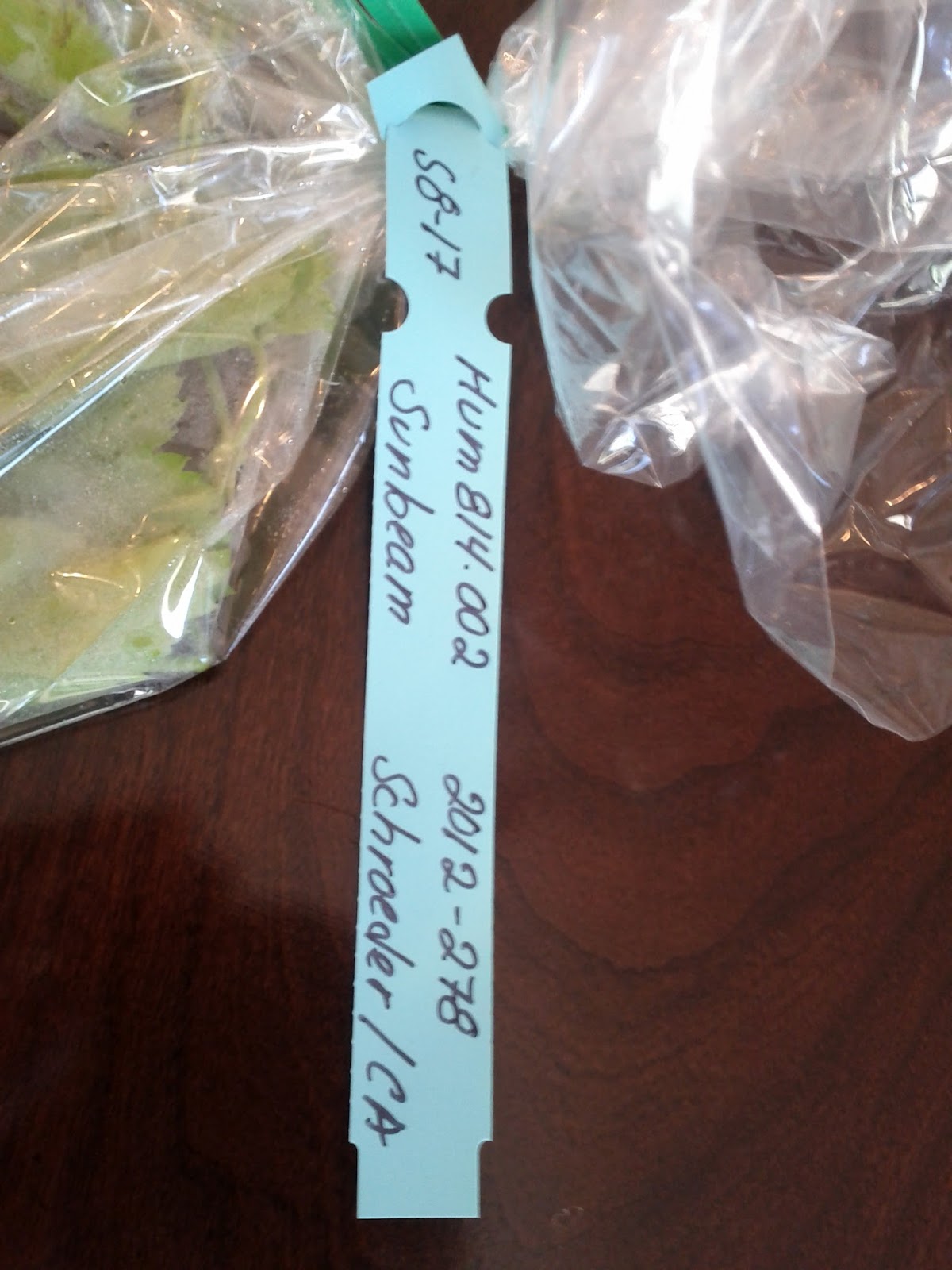
However, there is a lesser-known research arm of the USDA that strives to solve the everyday food and agricultural problems of average Americans.  One way they aim to do so is by providing access to the National Germplasm Cloning Repository.  The average American can request seeds and cuttings from a variety of different cultivars like pears, blackberries, strawberries, quince, gooseberries and hops among others.  Availability is limited, but those interested in researching experimental varieties of plants can make free requests on the ARS website.  In early March I made a request for three hop cultivars, hoping to grow them to maturity and use the hops in homebrew.  I had pretty much forgotten about the request, when today I received a package with my cultivars and growing medium included!  Here's what I received and what I know about them:
Gov'ment hops.

Hallertauer Magnum

Sometimes just called Magnum, this is the familiar and popular bittering hop with German aroma and flavor characteristics derived from Mittlefrüher and Galena.  American grown versions are more correctly labeled Yakima Magnum.  11.0 - 16.0% AAU range.

Sunbeam

Very similar to Saaz and used primarily in lager beers for flavor and aroma.  Also known as "Golden Hops" due to its cone coloration.  3.0 - 5.5% AAU range.

Talisman

A descendant of Cluster bred originally in 1968 as a disease-resistant bittering hop, but no longer commercially viable.  6.0 - 10.0% AAU range.


Tuesday, July 3, 2012

San Diego County Fair Homebrew Competition

I entered a beer in the homebrew competition at the San Diego County Fair this year.  It's one of the largest single day beer competitions in the world with over 1200 entries and it was a lot of fun besides.  With all of the enthusiasm for brewing that people in San Diego have it was no wonder I saw so many different people trucking in coolers of precious hand-crafted ale and lager to be critically evaluated.  You can officially enter ten different beers, but I only had one in bottles that I thought warranted sharing with people other than close friends and family.
Big lines just for dropping off entries.

I submitted Senne Valley Saison into category 16E: Belgian Specialty Ale because it was spiced with coriander seed and dosed with Brettanomyces near the end of fermentation.  The beer came out clear and light orange, with a delicate carbonation and a smooth even taste.  It's dry and hints at tartness that doesn't really come through.  It also smells very nice, being somewhat reminiscent of Orval.

The atmosphere at the competition was fraternal to the utmost with pretty much everyone in attendance excited to be there.  When the first round results were announced, with only 30 odd beers (one for each BJCP category) moving on to the Best of Show round, all of the remaining entrants in attendance started opening their other beer (the one brought in case a first round category win happened and a second bottle was needed).  It sort of (de)generated into a big party.  Jeff from Bikes, Beer & Adventures earned a second place in the Sour Beer category and was kind enough to let me sample his winning Flanders and drop some knowledge about blending.  He also shared a bottle of his Oud Bruin that I thought was really interesting.  I also got to try beers from other participants as well.  
Category 16 judging in progress.

Unfortunately, Senne Valley Saison didn't place in the competition.  I'm looking forward to getting the judges scores in the mail even though I'm told they used a short form version of the BJCP scoresheet that doesn't really allow for detailed comments.  Maybe I'll have better luck next year.

Thursday, June 21, 2012

Kentucky Bound

Beautiful Kentucky Lake
I'll be heading to the South Central United States later this week for an extended vacation on the shores of Kentucky Lake.  It's a beautiful place, wooded and green with inlets and waterways weaving in and out of two massive bodies of connected water.  It's become an (extended) family tradition to spend a week there with friends every other summer, leaning hard on the generosity of the Lewis family, who graciously invite us to stay there and enjoy their vacation home.  The trip is mostly about connecting with family and friends in a place devoid of airs and expectations.  We swim and boat on the lake, cook communal meals, relax in the cabin, watch the kids play, and generally just unwind.  This year there are five families going-seventeen people in all!  


As you might expect, we also drink some beer while there.  Traditionally, each person selects a brand of American Lager to drink.  This helps distinguish who beers belong to and facilitates consumption at "vacation levels."  In the past, I've always gone with Busch.  It is pretty tasteless and smooth, with a nice solid 4.7% ABV (higher than most others in the same category) and its irreverent slogan is somehow endearing ("Cold As A Mountain Stream, Smooth As Its Name").  This year I got curious about craft beer in Kentucky so I did a little research, figuring there might be a local brew I could pick up instead of mass-produced, soulless swill.  The results are a little discouraging.  The latest comparative statistics are from 2009 and list 6 total breweries in the entirety of the Bluegrass State; California boasted 238 in that same study.  Granted there have been some changes in the past few years with more breweries opening and even more planned.  The Brew Grass Trail website keeps an updated list of craft breweries in KY, but there's not much where we're going.  I guess I'll be sticking with Busch again this year.  We have an equation that we use to figure out how much beer to purchase en route to the lake house, as it is located in a dry county and you have to plan ahead:  


                  k
[d x b] x r  =  h


where:

d = days in KY
b = number of beers you'd drink daily in ideal conditions
r = the responsibility factor (expressed as a decimal number less than 1 to indicate % fewer beers you would consume if you were supposed to be "responsible")
k
 = exponential value to be assessed in relation to r determined by the number of kids you have
h = beer number representing your happy place

I ended up with 84 beers.  It's going to be a good vacation...